

About the H-1B 100k fee, 2026 H-1B lottery, and other key changes for employers, workers, and entrepreneurs.
An analysis of the transformative changes to the H-1B visa program in 2025/2026, including the $100,000 fee, weighted selection process, social media vetting, and entrepreneurial pathways.
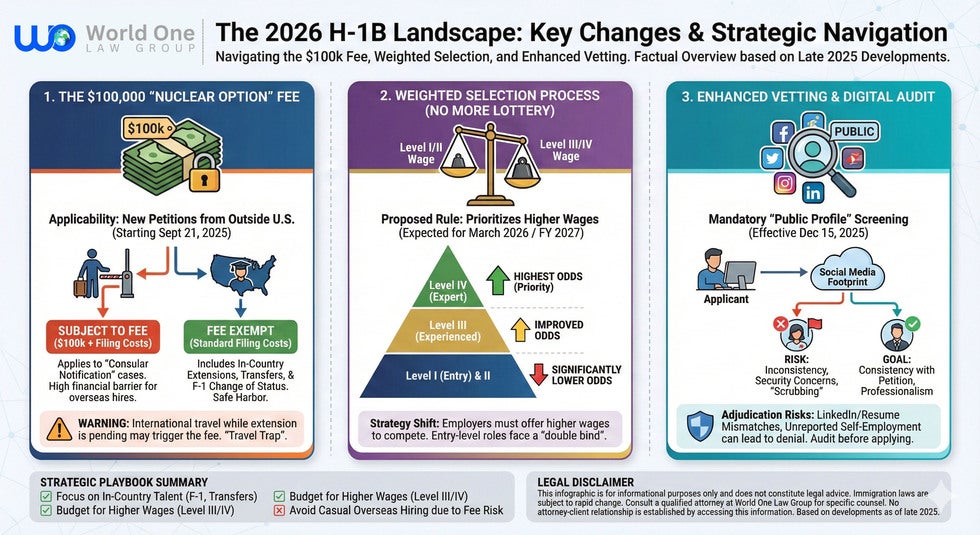
Introduction: A New Era of Business Immigration
The landscape of U.S. business immigration has historically been a dynamic environment, subject to the ebb and flow of political tides, economic necessities, and legislative debates. However, the transformation witnessed in the latter half of 2025 represents a paradigm shift of unprecedented magnitude.
For decades, the H-1B specialty occupation visa has served as the primary arterial link connecting United States employers with the global reservoir of high-skilled talent. It has been the engine of growth for Silicon Valley, the lifeline for rural healthcare systems, and the bridge for academic research. Yet, as we enter the 2026 application cycle, the fundamental architecture of this program has been radically altered by executive fiat and regulatory overhaul.
About This Report
Prepared by World One Law Group, this comprehensive report is a definitive introductory guide for employers, human resources executives, and foreign nationals navigating this changing terrain. Our firm is founded on the principle of bringing people together through the compassionate and expert navigation of complex legal systems. We recognize that behind every petition is a person, a family seeking a new life, a startup founder chasing a dream, or a talented mind ready to improve the world.
In a climate now defined by the "Restriction on Entry of Certain Nonimmigrant Workers" Proclamation and its accompanying $100,000 fee, alongside the proposed "Weighted Selection Process," the importance of accurate information and foresight have never been higher.
Impact on Employers
As of December 2025, the H-1B program is no longer merely a bureaucratic process; it has become a resource-intensive strategic challenge. The introduction of a $100,000 supplemental fee for new overseas petitions effectively places a tariff on global talent, fundamentally changing the cost-benefit analysis of international hiring. Simultaneously, the shift from a random lottery to a wage-based selection system threatens to close the door on entry-level professionals and recent graduates, favoring only the highest-paid senior experts. Furthermore, expanded social media vetting protocols introduced in December 2025 have added a layer of intrusive scrutiny and risk to the visa issuance process.
This report provides an analysis of these developments. We will examine the "travel traps" that can trigger the $100,000 fee for current employees, explore the mathematical realities of the new weighted lottery, and outline the narrow but vital pathways for entrepreneurship under the Modernization Rule. The maze of U.S. immigration has become more intricate, but with the right map, it remains navigable.
The Foundations of the H-1B Program
To fully comprehend the seismic nature of the 2025 reforms, one must first understand the bedrock upon which the H-1B program was built (pre-2025 context).
The "Specialty Occupation" Standard
The core statutory requirement of the H-1B visa, derived from the Immigration and Nationality Act (INA), is the concept of the "specialty occupation." This definition has not changed, even as the costs and procedures have. A specialty occupation is defined as a position that requires the theoretical and practical application of a body of highly specialized knowledge. Historically, and currently, this necessitates:
- Educational Threshold: The specific duties of the position must be so complex that they can only be performed by an individual with a bachelor's degree or higher (or its equivalent) in a specific specialty directly related to the role (8 CFR § 214.2(h)(4)(iii)).
- Nexus of Specialty: It is not enough to hold a degree; there must be a direct nexus between the coursework and the job duties. A general business degree for a marketing role often invites scrutiny, whereas a computer science degree for a software engineer is the archetype of a clear nexus.
World One Law Group Insight: While the definition remains constant, the adjudication has tightened. In the context of the new "Project Firewall" enforcement initiative (as discussed by DOL press releases), we are seeing increased demands for evidence proving that the degree is not just common to the industry, but absolutely essential to the specific role offered.
The Numerical Cap and the "Lottery" Era
Congress established a statutory limit on the number of new H-1B visas issued each fiscal year, creating a scarcity economy that defined the pre-2025 era.
- The Regular Cap: 65,000 visas available annually for the general pool.
- The Master's Cap: An additional 20,000 visas reserved exclusively for beneficiaries possessing a master's degree or higher from a U.S. institution of higher education.
For over a decade, demand has vastly outstripped this supply. In FY 2025, USCIS received approximately 442,000 registrations for these 85,000 spots (USCIS H-1B Cap Season Updates). To manage this excess demand, USCIS implemented a Random Selection Process (the lottery). Under this system, every registration—whether for a junior analyst earning $60,000 or a senior architect earning $200,000—had an equal mathematical probability of selection.
The randomness of this system was viewed by some as egalitarian and by others as economically inefficient. It allowed smaller businesses and startups to compete on equal footing with tech giants, provided they had the luck of the draw. However, critics argued it depressed wages by allowing the entry of lower-paid workers over higher-paid experts (e.g., CIS.org reports). This critique formed the ideological basis for the shift to the Weighted Selection Process discussed later.
Cap-Subject vs. Cap-Exempt: The Critical Distinction
A foundational distinction in the H-1B program is the categorization of employers. This distinction has become critically important in 2026 as the $100,000 fee often hinges on the nature of the petitioning entity.
| Category | Description | Cap Impact | 2026 Fee Implication |
|---|---|---|---|
|
Cap-Subject |
Standard commercial enterprises (profit-seeking). Includes most tech companies, banks, retail, and manufacturing. |
Subject to the 85,000 annual limit and the lottery. |
High Risk: Primary targets of the $100,000 fee and weighted selection. |
|
Cap-Exempt |
Institutions of higher education, non-profit entities affiliated with higher education, and non-profit/government research organizations. |
Exempt from the annual limit. Can file year-round. |
Nuanced: While exempt from the lottery, they may still be subject to the fee if hiring from abroad, depending on final rule interpretation. |
Dual Intent and the Path to Permanence
One of the H-1B's most valuable features is "Dual Intent." Unlike tourist (B-2) or student (F-1) visas, which require the applicant to prove they have no intention of abandoning their foreign residence, the H-1B allows the holder to intend to immigrate permanently (INA § 214(h)). Pre-2025: This allowed H-1B workers to travel freely while a Green Card application was pending. 2026 Context: The new social media vetting and fee rules have complicated this. While dual intent remains legal, the process of re-entering the U.S. has become fraught with financial risk (the $100k fee) and privacy intrusions.
H-1B 100k fee (Trump 100k H1B Proclamation)
The single most disruptive change to the U.S. immigration system in recent history is the Presidential Proclamation titled "Restriction on Entry of Certain Nonimmigrant Workers," signed on September 19, 2025. This executive action fundamentally alters the economics of global mobility.
The Legal Authority and Intent
The Proclamation relies on Section 212(f) of the Immigration and Nationality Act (INA), which grants the President broad authority to suspend the entry of any class of aliens deemed detrimental to the interests of the United States.
- Stated Justification: The text of the Proclamation explicitly cites the protection of the U.S. labor market, arguing that the H-1B program has been "deliberately exploited to replace, rather than supplement, American workers with lower-paid, lower-skilled labor."
- The Mechanism: Rather than a ban, the administration imposed a "financial condition of eligibility"—a $100,000 supplemental fee—intended to eliminate the cost advantage of hiring foreign labor.
Operational Mechanics: How the Fee Works
The implementation details released by USCIS on October 20, 2025, clarify the scope and application of this fee (USCIS Policy Alert, Oct 2025).
Applicability (The "Outside" Rule)
The fee is not universal. It is targeted specifically at the introduction of new workers into the U.S. economy.
- Who Pays: The $100,000 fee must accompany any new H-1B petition filed on or after September 21, 2025, where the beneficiary is physically outside the United States and does not currently hold a valid H-1B visa.
- Consular Notification: Any petition requesting "Consular Notification" (signaling the worker will apply for a visa at an embassy) is presumptively subject to the fee.
- Payment Logistics: The fee is in addition to standard filing fees (I-129, Fraud Fee, ACWIA fee). It must be paid via Pay.gov, and proof of payment must be included in the petition packet. Failure to include this proof results in immediate rejection.
The "Travel Trap" for Current Workers
A critical area of confusion—and danger—lies in the treatment of workers currently in the U.S. seeking extensions or amendments.
- Safe Harbor: Petitions filed for beneficiaries inside the U.S. requesting a "Change of Status" or "Extension of Stay" are exempt from the $100,000 fee (USCIS Memorandum).
- The Trap: If a worker travels internationally while an extension petition is pending, USCIS policy dictates that the "Extension of Stay" request is considered abandoned. The petition converts to "Consular Notification."
- Result: Because the adjudication now involves a beneficiary who will seek re-entry from abroad, the petition may become retroactively subject to the $100,000 fee.
World One Law Group Insight: Strictly avoid international travel while any H-1B petition is pending. If travel is unavoidable, the employer must be prepared to pay the fee or face a denial. We recommend consulting with us before any international travel if you have a pending H-1B petition.
Exemptions and Safe Harbors
Understanding who is not subject to the fee is as important as understanding who is.
- In-Country Renewals: H-1B extensions for the same employer, or transfers to a new employer, provided the beneficiary remains in the U.S. and maintains valid status.
- Valid Visa Holders: Individuals who possessed a valid H-1B visa stamp before the effective date (September 21, 2025) are generally protected, allowing them to travel and re-enter without triggering the fee.
- National Interest Exceptions (NIE): As detailed below, specific categories deemed vital to national security.
National Interest Exceptions (NIE)
The Proclamation allows the Secretary of Homeland Security to waive the fee if the entry of the individual is in the "National Interest". However, the bar for this exception is set exceedingly high. Criteria for NIE:
- Critical Infrastructure: The worker must provide vital support to critical infrastructure sectors as defined by CISA (e.g., Energy, Healthcare, Defense, Information Technology relevant to security).
- Non-Displacement: The employer must prove that no qualified U.S. worker is available for the role. This effectively supercharges the Labor Condition Application (LCA) requirement.
- Significant Harm: The petitioner must demonstrate that not granting the waiver would cause significant harm to U.S. interests (not just financial loss to the company).
Case Study: The "Critical" Engineer
Consider a hypothetical Lead Cybersecurity Analyst at a major defense contractor. Scenario: The analyst is currently in India. The employer needs them in Washington, D.C. immediately. NIE Argument: The employer argues the analyst is securing networks used by the DOD. Outcome: Likely strong candidate for NIE due to "Critical Infrastructure" (Defense/IT) and government contract nexus.
Case Study: The "Commercial" Developer
Consider a Software Developer for a retail app. Scenario: New hire from Europe. NIE Argument: The developer improves the app's efficiency, helping the U.S. company grow. Outcome: Unlikely to qualify. Commercial growth alone rarely satisfies the "National Interest" standard under this stringent definition.
Economic Implications
The $100,000 fee creates a bifurcation in the labor market.
- For Startups: The fee is prohibitive. A pre-seed or Series A startup generally cannot afford a $100,000 premium on top of salary. This effectively locks startups out of the overseas talent market.
- For Big Tech: While challenging, large corporations may absorb the cost for "purple squirrel" candidates (rare, highly specific talent). However, they are likely to reduce overall volume.
- For Domestic Graduates: The fee creates a massive incentive to hire F-1 students already in the U.S. Since shifting an F-1 student to H-1B via "Change of Status" is fee-exempt (beneficiary is in the U.S.).
World One Law Group Insight: “Student” F-1 graduates have suddenly become $100,000 cheaper than their overseas counterparts. However, they may be riskier applicants.
The Weighted Selection Process (The End of the Lottery)
While the Proclamation addresses the cost of labor, the Department of Homeland Security's proposed rule regarding "Weighted Selection" addresses the selection mechanism itself. Moving away from the "random" lottery, this rule seeks to prioritize petitions based on salary levels.
The Shift from Random to Merit
On September 24, 2025, DHS published a Notice of Proposed Rulemaking (NPRM) to replace the random selection process with a wage-based system. Selection probability is tied to the Department of Labor's Occupational Employment and Wage Statistics (OEWS) levels (DOL OEWS Data).
| Wage Level | Description | Number of Entries | Selection Probability Change |
|---|---|---|---|
|
Level I |
Entry Level / Beginning |
1 Entry |
-48% Decrease* |
|
Level II |
Qualified / Moderate Experience |
2 Entries |
+3% Increase* |
|
Level III |
Experienced / Senior |
3 Entries |
+55% Increase* |
|
Level IV |
Fully Competent / Expert |
4 Entries |
+107% Increase* |
*Estimated by Forbes Immigration Analysis
World One Law Group Insight: This is not a subtle nudge. The data indicates that Level I petitions will become statistically non-viable. If a Level IV petition has 4x the entries of a Level I, the lottery will be dominated by high-wage earners.
The "Wage Inflation" Dilemma
This system forces employers into a difficult strategic position. To ensure a reasonable chance of selection, they must offer wages at Level III or Level IV. The Dilemma: An employer wants to hire a fresh graduate (typically Level I). To get them selected, the employer might need to offer a Level III salary (often $120k+ for tech roles). This creates wage compression issues internally (paying new hires more than existing staff) and inflates the cost of doing business. Regulatory Guardrails: DHS has anticipated "gaming" where employers register at Level IV but pay Level I. The rule requires that the petition must match the registration. If an employer wins the lottery based on a Level IV registration but files a petition with a Level I LCA, the petition will be denied (DHS Proposed Rule, Sept 2025).
Impact on F-1 Students and Recent Graduates
The weighted selection process is particularly punitive for international students graduating from U.S. universities. The Entry-Level Trap: By definition, recent graduates usually qualify for Level I (entry-level) wages. They lack the experience to justify Level III/IV classification under DOL standards. The Result: F-1 students face a "double bind." They are the most attractive candidates financially (exempt from the $100k fee), but they are the least likely to be selected in the weighted lottery due to their lower wage levels. Strategic Pivot: Employers may need to restructure positions to justify Level II wages for graduates, perhaps by requiring master's degrees or specific niche skills that push the role out of the "entry-level" bracket.
Timeline for Implementation
The comment period for this rule closed on October 24, 2025. Given the administrative timeline, it is highly probable that the Final Rule will be published in late 2025 or January 2026, making it effective for the March 2026 (FY 2027) registration season. World One Law Group Insight: H1B hiring strategy has become more customized to each company's needs, which requires a deeper understanding of the current law. Employers must plan for this reality now.
The Vetting Wall: Social Media and Security
In parallel with financial and selection barriers, the U.S. government has expanded its surveillance and vetting capabilities regarding visa applicants.
The "Public Profile" Mandate (Dec 15, 2025)
Effective December 15, 2025, the Department of State expanded social media screening requirements to include H-1B applicants and H-4 dependents. Previous Scope: Limited primarily to F, M, and J visas or those flagged for additional scrutiny (DS-5535). New Scope: Mandatory for H-1B/H-4. Applicants are instructed to adjust privacy settings on all social media profiles to "Public" for the duration of the visa application process.
Adjudication Risks
Consular officers are trained to review "online presence" for indicators of inadmissibility (Foreign Affairs Manual (FAM) guidance).
- National Security: Posts sympathizing with groups designated as terrorist organizations or advocating violence.
- Visa Fraud/Inconsistency: This is the most common risk for professionals. Officers compare LinkedIn profiles with the visa application. Example: An applicant claims to be a "Software Engineer" on the H-1B petition but lists "Founder/CEO" of a stealth startup on LinkedIn. This discrepancy suggests unauthorized self-employment or misrepresentation of the role, leading to denial.
- Drug Use: Admissions of marijuana use (even if legal in the state of employment) on social media can lead to permanent inadmissibility under federal immigration law.
World One Law Group Insight: Audit Before Application: We advise all clients to conduct a thorough audit of their social media footprint before submitting any forms. Ensure consistency between your CV, LinkedIn, and the petition details. The "Scrubbing" Risk: Be cautious. Mass deletion of data immediately prior to an interview can be interpreted as "evasive behavior," triggering a deeper forensic review. The goal is accuracy and professionalism, not concealment.
The Entrepreneurial Door: H-1B for Founders
Amidst the restrictions, a significant opportunity has been codified for foreign entrepreneurs. The "Modernization Rule," effective January 17, 2025, clarified the path for "Owner-Beneficiaries." Historically, USCIS often denied H-1B petitions for startup founders because a person cannot "employ" themselves. The agency argued that if a beneficiary owned 51% of the company, they could not be "fired," and thus no valid employer-employee relationship existed.
The Change: The new rule explicitly permits H-1B beneficiaries to possess a controlling interest (more than 50%) in the petitioning entity (8 CFR § 214.2(h)(4)(ii)). Requirement: The beneficiary must demonstrate that they will perform specialty occupation duties for the majority of their time. They cannot merely be a "passive" owner or perform only general executive tasks (like fundraising) that do not require a specific degree.
The 18-Month Constraint
To prevent abuse, the regulations impose stricter validity periods on owner-beneficiaries.
- Initial Validity: Limited to 18 months (standard H-1B is 3 years) (8 CFR § 214.2(h)(9)(iii)).
- First Extension: Limited to 18 months.
- Subsequent Extensions: Can be up to 3 years, subject to the 6-year total max.
Evidence for the Founder H-1B
Success in this category requires a robust evidentiary packet:
- Business Plan: Detailed roadmap showing financial viability.
- Capitalization: Bank statements showing the company can pay the salary.
- Governance Documents: Articles of Incorporation, Operating Agreements.
- Bona Fide Job Offer: Contracts or Board resolutions proving the job exists distinct from the ownership.
World One Law Group Insight: This is a vital pathway for founders who do not yet qualify for the O-1 (Extraordinary Ability) visa. However, the 18-month renewal cycle means legal costs will be higher over the life of the visa.
The "Trump Gold Card" H1B Alternative?
A separate, highly speculative proposal, often referred to as the "Trump Gold Card" or "Platinum Card," has been discussed as a potential alternative to the H-1B for high-skilled individuals. This concept, if implemented, would reportedly offer an expedited path to permanent residency for foreign graduates with advanced degrees from top U.S. universities, particularly in STEM fields.
While details remain scarce and it is not currently an official program, such a "Gold Card" could serve as a direct competitor or alternative to the H-1B for a very specific, elite subset of the talent pool. It would bypass the H-1B cap and its associated fees and lottery, offering a direct path to a Green Card. However, it is unlikely to be broad enough to serve the vast majority of H-1B applicants, especially those in non-STEM fields or with bachelor's degrees. For now, the H-1B remains the primary work visa, even with its increased complexities.
Strategic Playbook for FY 2027 (March 2026)
As we approach the March 2026 registration season, employers must synthesize these disparate rules (Fees, Weighted Selection, Vetting) into a coherent strategy.
The "World One" Decision Matrix for 2026
| Candidate Profile | $100k Fee Risk? | Lottery Strategy (Weighted) | Vetting Risk? | World One Verdict* |
|---|---|---|---|---|
|
New Hire from Abroad (e.g., India) |
YES ($100k) |
Must offer Level III/IV Wage. |
High (Consular Interview). |
Avoid unless critical. Cost >$150k yr 1. |
|
F-1 Student (in U.S.) |
NO ($0) |
Difficult. Level I wage has low odds. |
Moderate (Change of Status). |
High Value. Fee-exempt, but difficult to win lottery. Offer higher wage if possible. |
|
H-1B Transfer (in U.S.) |
NO ($0) |
N/A (Cap Exempt). |
Low (No travel needed). |
Best Option. Fee-exempt and lottery-exempt. |
|
Founder (in U.S.) |
NO ($0) |
N/A if Cap Exempt / Hard if Subject. |
Moderate. |
Viable under new Modernization Rule (18-mo validity). |
* For general information only.
Budgeting for FY 2027
The cost of an H-1B has skyrocketed.
- Old Budget: Legal Fees (~$5k) + Filing Fees (~$2.5k) = ~$7,500.
- New Budget (Overseas Hire): Legal + Filing + $100,000 Fee = ~$107,500.
- New Budget (Lottery Strategy): Legal + Filing + Salary Premium (Moving from Level I to Level III might mean +$40k/year in salary).
Compliance: Project Firewall
The Department of Labor's "Project Firewall" is actively auditing H-1B employers (DOL Press Release on Enforcement). The Target: Employers who register at Level IV to win the lottery but pay Level I wages, or who "bench" employees without pay. The Penalty: Back wages, civil fines, and debarment from the immigration system. Action Item: Ensure that the wage listed in your registration is the wage you actually intend to pay, and that it is supported by the company's financial data.
2026 Speculations and Outlook
- Litigation: The lawsuit Global Nurse Force et al. v. Trump is challenging the $100,000 fee. While a preliminary injunction is possible, employers cannot plan their hiring strategy on the hope of a court victory. The prudent path is to assume the fee stands.
- Finalization of Weighted Rule: We expect the Weighted Selection rule to be finalized by January 2026. Any delay beyond that might push implementation to FY 2028, but current indicators suggest it will be ready for the upcoming season.
The Path Forward in 2026 and Beyond
The U.S. immigration system has evolved from a process of bureaucratic management to one of high-stakes asset management. The introduction of the $100,000 fee and the weighted selection process has created a system that is undeniably more exclusive, expensive, and meritocratic in a purely financial sense. However, the door is not closed:
- For Employers: The strategy can shift to retaining domestic international talent (F-1 students) and maximizing the potential of current H-1B holders through transfers. The era of casual offshore hiring is paused.
- For Talent: The focus must shift to skill acquisition that justifies Level III/IV wages and maintaining an impeccable legal and digital online personal and professional record.
At World One Law Group, we remain committed to our mission of bridging borders. The "World One Way" is about navigating these complexities with compassion and precision. We help you audit your workforce, plan your hiring budget, and prepare the rigorous evidence needed for National Interest Exceptions or Founder petitions.
Legal Disclaimer: This article is for informational purposes only and does not constitute legal advice. The information provided is intended to provide a general overview of the H-1B program and current developments as of the published date. It is not a substitute for the professional judgment of an attorney.

Comments
There are no comments for this post. Be the first and Add your Comment below.
Leave a Comment